
 EN
How Does a Gearless Full-Servo plastic bag printing machine Achieve ±0.1mm Registration Accuracy?
A plastic bag printing machine can align successive colors by coordinating print-cylinder motion, monitoring the film and correcting deviations as the web travels through the press. A gearless, servo-driven design can contribute to that control, but the headline figure of ±0.1 mm is a proposed tolerance, not a verified result for a particular machine. Whether it is attainable depends on the press configuration, film, artwork, operating conditions and measurement method. Ask for a witnessed test before treating that figure as a purchase specification.
What registration accuracy actually measures
Registration describes how closely one printed color lands in its intended position relative to another. On a plastic bag printing machine, a longitudinal error shifts a color along the direction of travel; a lateral error shifts it across the web. Both matter when type, borders or fine graphics must line up. The mark-to-mark distance on the printed web is not the same as a drive motor's positioning error: material movement, plate mounting and the measuring system also affect the result.
A stated ±0.1 mm target needs a reference: which color is the datum, which direction is measured, and is the limit applied to each individual sample or to a statistical summary? It also needs a defined sampling interval, instrument resolution and treatment of start-up, speed changes and steady running. Without those details, two identical-looking claims may describe different tests.
How servo synchronization can support alignment
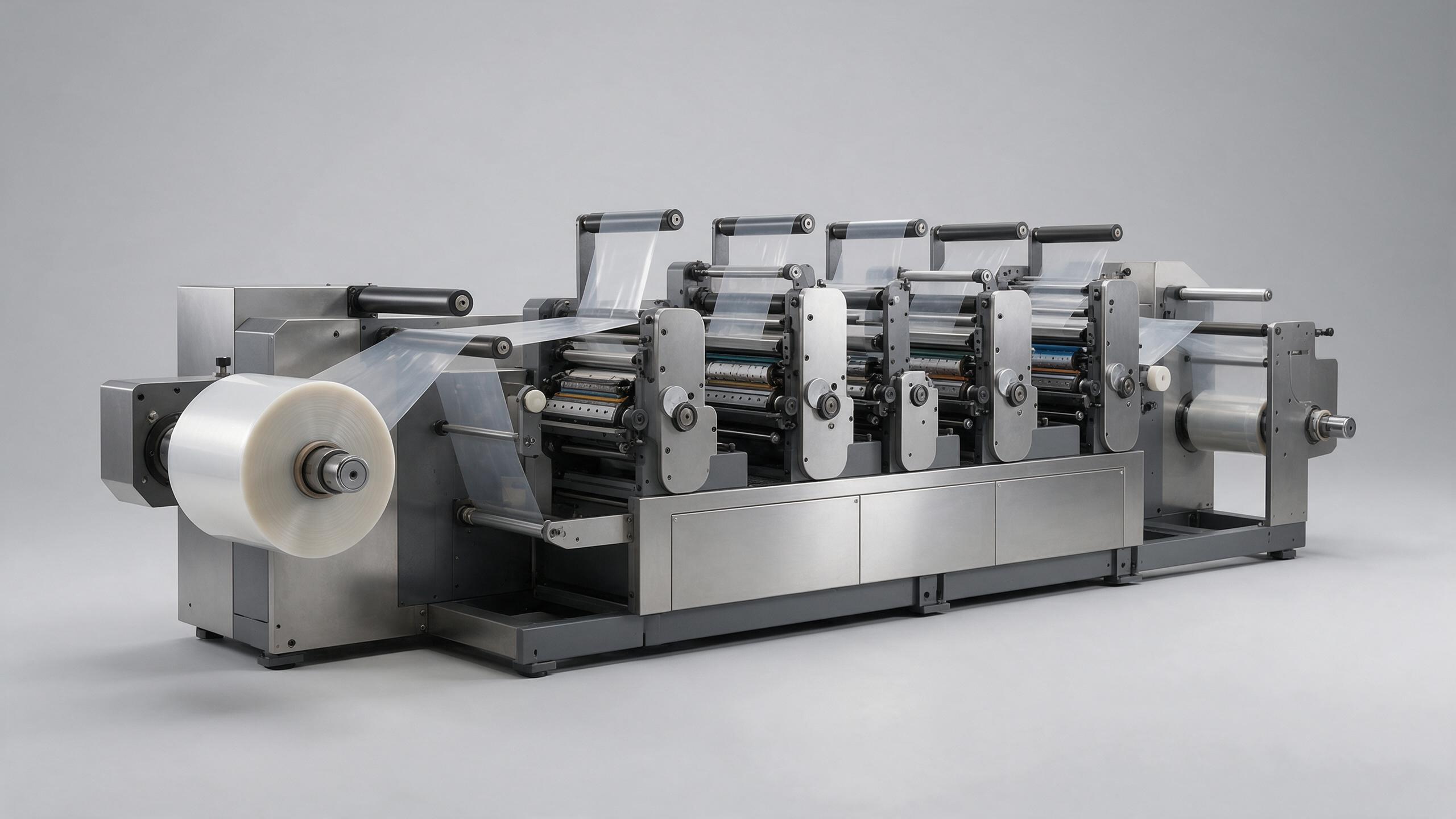
In a gearless plastic bag printing machine, independently driven printing cylinders may be coordinated electronically rather than relying on a shared mechanical gear train for their relative motion. A controller compares commanded positions with feedback from the drives and adjusts motion to maintain the intended phase relationship. The specific architecture and the axes under servo control vary by design, so confirm what the proposed configuration actually includes.
Removing a common gear train can avoid some sources of mechanical transmission error, such as backlash in that path. It does not remove every mechanical error: cylinder condition, mounting, bearings and drive response still matter. A Full-Servo Plastic Film Flexo Press should therefore be evaluated as a complete motion and web-handling system, not as a label that establishes a tolerance.
From marks to correction
Where an automatic registration system is fitted, a sensor can read printed marks for successive colors. The controller calculates their relative displacement and issues a correction to a relevant axis. Confirm whether the quoted plastic bag printing machine measures both directions, which colors it monitors, how the operator sets the reference, and whether correction operates continuously or under specified conditions.
Measurement and correction take time. Sensor contrast, mark quality, control response and the distance between print units all influence how the loop behaves. Ask the supplier to demonstrate what the system does after a controlled disturbance and how long it takes to settle, rather than judging only a single stable sample.
Why film tension and temperature matter
Plastic film stretches when tension changes. If the web length between color stations changes, a later color may shift even when each cylinder follows its command. The plastic bag printing machine must handle unwind, infeed, printing and rewind conditions as a connected process. A stable tension setup can reduce a source of variation, but the usable settings depend on the material and job.
Heat from drying can also change film behavior, and the path through rollers affects the span over which alignment is maintained. Ask how the proposed press controls tension in each zone, what feedback is available, and how drying settings are established for the intended ink and film. Avoid assuming that one setting transfers unchanged from a thick, stiff web to a thinner or more extensible material.
Other sources of register variation
Even with electronic phase control, a plastic bag printing machine depends on consistent preparation. Plate mounting errors can place the image off its intended position. Cylinder or sleeve condition, impression settings and roller alignment can change how the image transfers. Ink, drying and substrate behavior can affect the marks that the sensor reads or the appearance of the printed edge.
Consider an illustrative job with two colors and a narrow border. If the marks drift slowly as a roll unwinds, examine tension and roll conditions before changing plate position. If the error repeats at a particular point in each revolution, inspect the repeat, mounting and cylinder condition. These are diagnostic starting points, not proof of a particular fault; use the supplier's operating procedure and record each adjustment.
How to test a ±0.1 mm target
For a meaningful acceptance test, agree on the method before ordering a plastic bag printing machine. Supply the intended film type, thickness and width, ink system, artwork, number of colors and print repeat. Define the speed range and whether the test includes acceleration, deceleration and roll changes. The supplier can then identify the configuration and test conditions it is prepared to support.
- Define a reference color and separate longitudinal and lateral limits. State whether ±0.1 mm is an individual deviation from the reference or another agreed measure.
- Choose readable marks and a calibrated instrument suitable for the tolerance. Agree how measurement uncertainty is handled, including a retest or guard band when a reading is close to the limit.
- Collect samples at agreed positions across the roll and at specified time or length intervals. Include start-up, steady running and any transitions within the acceptance scope.
- Record each reading, direction, speed, tension settings, substrate details and any intervention. Report the range and the number of samples outside the agreed limits, not just a selected favorable print.
- Have both parties review the raw readings and retain representative samples with the test report. A result applies to the tested configuration and conditions; it is not evidence for every future job.
If the proposed plastic bag printing machine does not meet the target, separate systematic offset from variation over time. A repeatable offset may call for setup correction; changing error calls for investigation of process stability or measurement. Retest only after documenting the cause, the change and the same acceptance conditions. This makes comparison between quotations more useful than comparing nominal accuracy alone.
Questions to include in an equipment inquiry
Before requesting a quote for a Gearless plastic bag printing machine, share a representative artwork file and a sample of the actual film. Ask which axes are servo-driven, whether register sensors are included, what marks they require, and how operators observe and adjust alignment. Confirm the included drying and tension-control configuration, installation support, training and the scope of any on-site acceptance test.
Wenzhou Qiangtuo Machinery works in flexographic equipment for packaging applications. For a plastic bag printing machine inquiry, provide the substrate, production workflow and desired registration test conditions so the proposed scope can be discussed. Treat ±0.1 mm as a target to validate on the agreed job, not as a verified capability of an unspecified product.
 Hot News